
“It’s a continued direction towards no accountability…These are steps towards having a secret police.”
Jim Reeves, a former dispatcher for the Tulare County Sheriff’s Office and longtime Visalia watchdog, spoke to the Valley Voice about the quiet expansion of surveillance and privacy-eroding technology inside our local police departments.
Twice in three years, the Visalia City Council has quietly agreed to reduce what residents can see or hear from their own police force. In December 2022, the city spent $1.8 million on radios that encrypted police radios and scrambled transmissions, cutting off public scanners.
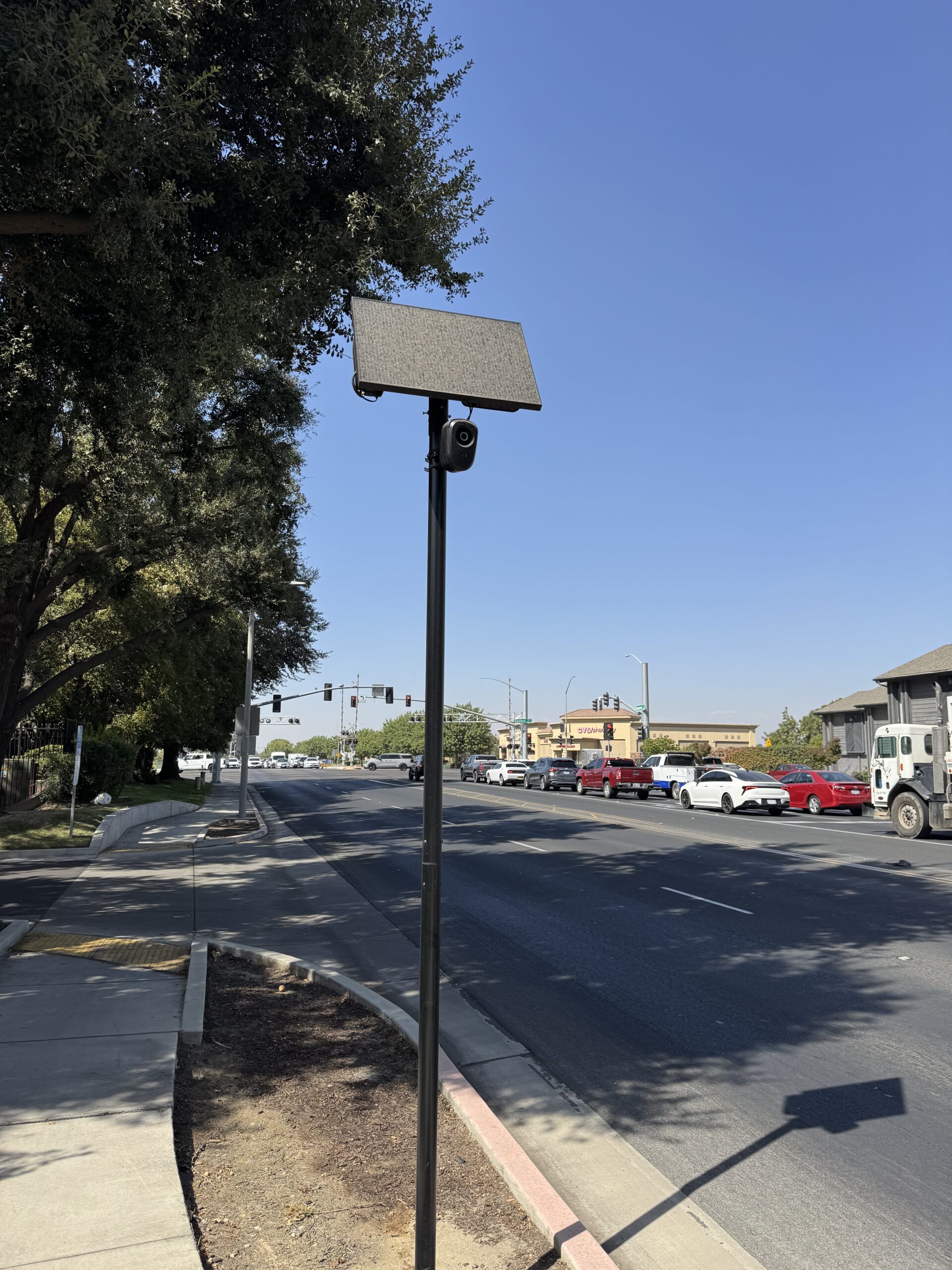
In October 2024, the Visalia City Council voted on $300,000 for a four-year contract with a company called Flock to install automated cameras that would read license plates across the city. Both times, the decisions arrived without a single question asked by the public.
Today, residents can no longer monitor city police traffic, and at least 22 Flock cameras are active or pending in Visalia, part of a larger patchwork of at least three separate Automated License Plate Reader (ALPR) networks.
Like the encrypted police radios, Flock cameras have flown under the public’s radar, silently expanding across Tulare and Kings County.
Forty percent reduction in stolen vehicles
The Voice spoke with Visalia Police Chief Jason Salazar and Operations Support Division Captain Andrew Swarthout specifically about Flock cameras and the growing concerns from the public.
One of the concerns making headlines recently involves ALPR technology being prone to error and misreading license plates, leading to innocent civilians being jailed or detained at gunpoint. When asked if Visalia’s Flock cameras might make similar errors, Salazar said there have been no wrongful-stop incidents in Visalia tied to Flock. He said the more likely culprit for wrongful detainments elsewhere is human error.
“Probably what’s more likely to happen is somewhere along the way, there was a human error. Someone that put the data into the system, maybe put a number or a letter wrong in the plate so the wrong plate was entered.”
Salazar explained that alerts from Flock cameras are only one part of the investigative process. Officers aren’t authorized to move on a stop or arrest the moment an alert comes in. Human confirmation is required first.
“The Flock alert is really nothing more than an investigative lead. It says, ‘Hey, the camera detected a license plate that is wanted for whatever reason…’ They then run the license plate themselves, do their own investigation to make sure that the vehicle that they found is actually the vehicle that is wanted.”
Salazar and Swarthout described the system’s effectiveness by citing VPD’s own statistics. According to their data, 2025 saw a 39% reduction in stolen vehicles, which VPD attributes to the Flock cameras it began using in 2024.
“The number of stolen vehicles went way down, and we’re on pace to meet that so far in 2026, where we’ve made arrests in 40% of the stolen vehicle cases,” Salazar said
Wrongful stops aren’t the only concern on residents’ minds. There are also worries about Flock data being misused by law enforcement to stalk people, or accessed by federal agencies to aid in the deportation of undocumented immigrants.
On the question of misuse, Salazar and Swarthout said they run their own internal audit every week to catch it, and that Flock includes a feature that automatically flags suspicious search behavior for Salazar’s review. Officers, dispatchers, and staff must complete training before they’re granted access to Flock data, and every use is logged.
“Date, time, what it was that they were doing, what they searched, everything is tracked,” Salazar said.
When asked whether any agency outside California law enforcement such as ICE or Border Patrol has access to VPD’s Flock data, Salazar was direct:
“We do not share with any federal agencies,” he said. “And in fact, if you’re a law enforcement agency in California, you’re not even allowed to turn on the federal sharing tab in Flock.”
That inability to enable federal sharing is a feature built to prevent the kind of scandals and lawsuits that have already hit other California police departments, several of which have faced legal action or cut ties with Flock entirely after their data was found flowing to agencies outside the state.
California restricts use and sharing of data
Two distinct California laws govern how police departments can use automated license plate readers like Flock’s. The first, Senate Bill 34, codified at California Civil Code sections 1798.90.51 through .90.55, requires any agency operating an ALPR system to provide an opportunity for public comment before implementing the program, publicly post a written usage and privacy policy, and restrict data sharing to “public agencies” within California. It also gives Californians the right to sue if their license plate data is shared improperly.
The second, Senate Bill 54, California’s broader “sanctuary state” statute, codified in Government Code section 7284, restricts the use of state and local law enforcement resources for federal immigration enforcement.
How these two laws apply specifically to ALPR data was left to interpretation for years after they took effect between 2016 and 2018. That changed in October 2023, when the California Department of Justice, under Attorney General Rob Bonta, stated directly in a bulletin that California law enforcement cannot share ALPR data with federal or out-of-state agencies, and that every agency’s usage and privacy policy must be public and transparent.
Visalia Police Department appears compliant on multiple fronts. Salazar says VPD is technically incapable of sharing data outside California even if it wanted to; its usage and privacy policy is posted on the department’s website; and the agency provided an opportunity for public comment at the October 21, 2024 City Council meeting where the Flock contract was approved.
That last point deserves scrutiny. The Flock contract, listed as Item 24-0415 on the Consent Calendar, was one of eleven unrelated items bundled together and approved in a single motion. No presentation was given. No council discussion occurred. And not a single member of the public raised a question about it, perhaps because it was buried among everything else on the Consent Calendar that night.
A similar tactic was used when the Visalia City Council approved encrypting police radios. The encryption item was listed in the consent calendar and approved along with many other unrelated items in one motion.
Is the CHP’s accessing of Visalia’s data monitored?
If Visalia’s Flock camera system has a shadow auditor, it’s Jim Reeves.
Before he was writing about Flock cameras on his website, jimmiejoe.com, Reeves spent 25 years as a dispatcher for the Tulare County Sheriff’s Office. Over the past several months, he’s used that experience to investigate VPD’s use of Flock data through public records requests.
He spoke to the Voice about the cameras’ rollout and was critical of how little transparency accompanied it.
“Flock makes a big thing in their press releases that these cameras were democratically approved, and that’s technically true. But most of it was consent calendar agendas that only the policy nerds really dig into,” he said.
Reeves’ skepticism isn’t limited to how Visalia approved buying Flock cameras in the first place, it extends to what’s happened with the cameras since. Through his own records requests, he obtained audit logs, and what he found puzzled him. The California Highway Patrol, he said, accessed Visalia’s camera data 42,000 times in a single 30-day period, compared to roughly 1,600 inquiries by VPD’s own officers in that same window.
“A CHP officer from Eureka [could be] checking Visalia with no expectation that the car he’s checking has ever been in Visalia. Why does he need to check Visalia’s data?”
The reports he received were also, in his view, disappointingly vague. VPD’s data listed the requesting agency and a reason for each inquiry — the same reason field Salazar referenced — but Reeves said most entries simply read “investigation.”
“It doesn’t say investigation of what,” he said. “Most of the inquiries are just fishing. It’s not investigation.”
He added that the audit itself isn’t public in real time. Records only surface after a public records request, and by then, the data is well out of date. “It’s very delayed,” he said. “So it’s not current data.”
According to Reeves, VPD has since removed the reason field from the public records it releases on Flock inquiries.
Reeves’ own records request, filed in April of this year, also requested any log of inquiries involving his own license plate. State law generally gives departments 10 days to respond to a records request; it took VPD nearly three months to fulfill his. When the records finally came, his request for information tied to his own plate was denied, citing the department’s own privacy policy.
That experience points to a broader question about the department’s transparency. If records related to Flock cameras are opaque enough that a resident can’t see the reason behind an inquiry, or obtain information about searches involving his own license plate, how transparent is the department?
When asked about Salazar’s assurance that California agencies are structurally unable to enable Flock’s federal-data-sharing setting, Reeves was skeptical that a togglable software setting could reliably hold up against unlawful remote access.
“That can be changed remotely by Flock, whether intentionally or unintentionally,” he said, pointing to an incident at the Ventura County Sheriff’s Office in early 2025, when a “vendor error” reportedly re-enabled data sharing to agencies outside the state, leading to more than 364,000 outside queries before it was caught.
Reeves said he isn’t opposed to ALPR technology itself. What troubles him is who owns and controls the data it generates, which isn’t the VPD or any other local agency.
“It would be different if they were controlled by the local agency, where the data is stored locally, where only the agency has direct access to it,” he said. Leaving that data in the hands of a private company, he said, leaves it vulnerable to breaches and to side-door loopholes federal agencies can use to gain access.
He was also blunt about the broader pattern he sees playing out: “There have been many instances where police have abused the system,” he said. “There are insufficient checks.”
Asked how he felt about radio encryption in tandem with the Flock rollout, Reeves said neither, on its own, alarms him as much as the two together.
“Each one of these things by itself doesn’t seem like much,” he said. “But it’s just a creeping, step by step, into more intrusive monitoring of the public.” It’s a continued pattern, he said, of no accountability and the public kept in the dark about what’s happening in its own city. “These are steps towards having a secret police.”
Not Just Visalia
Visalia PD isn’t the only department in the region using Flock cameras. College of the Sequoias PD, Hanford PD, Dinuba PD, Woodlake PD, and the Tulare County Sheriff’s Office all use the technology as well, though the Voice was not able to secure interviews with those agencies by publication.
Hanford Police Department is scheduled to present its own use of Flock technology at the city’s September 15 City Council meeting. Hanford’s Community Relations Manager Brian Johnson said the meeting is open to everyone and there will be opportunity for public comment.
The flock discussion will be during the study session portion of the meeting, which starts at 4 p.m.
“Reeves’ own records request, filed in April of this year, also requested any log of inquiries involving his own license plate. State law generally gives departments 10 days to respond to a records request; it took VPD nearly three months to fulfill his. When the records finally came, his request for information tied to his own plate was denied, citing the department’s own privacy policy.”
For what it is worth, “… his request for information tied to his own plate was denied, citing the department’s own privacy policy” violates the California public records act law.
In other words, a local government’s privacy policy does not trump California state law. And the California Public Records Act says that if it is a record, it must be provided when requested.
Now, local government can set the price for producing the records, and they can set the price high to discourage people from requesting the records, but if the requester is willing to pay, the government cannot just make up a b.s. privacy policy excuse for not supplying the records.
Some governments say that they don’t supply personnel (HR) records due to a privacy policy. Obviously that doesn’t apply to Mr. Reeves. Down in Los Angeles there was a public school coach who was accused of improper relations with a student, and the school district went ahead and _did_ publish his personnel file – so even those aren’t off the table.
Anyway, if VPD has a record, they must produce it. Period. That is California law.