
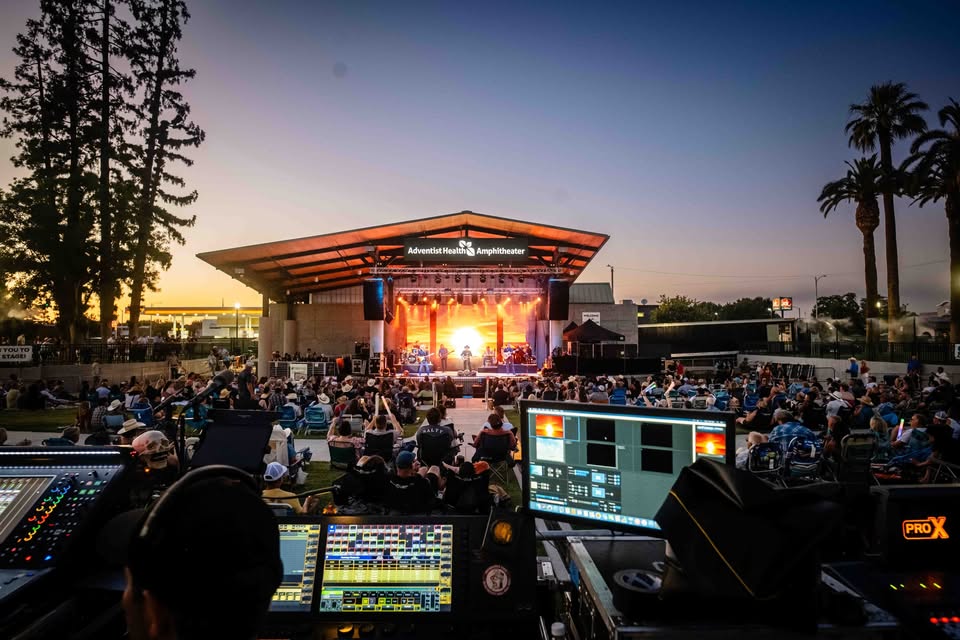
 The Tulare City Council approved an additional $160,000 to shore up the fledgling concert series at the Adventist Health Amphitheater in Zumwalt Park, bringing the total off-budget cash infusions from City Hall to $842,000 since December.
The added funding is in addition to the $400,000 earmarked for concert expenses in the city’s 2025-26 budget, and the $5 million in city funds used for construction of the theater.
Approval was not unanimous. The latest funding approval came in a 4-1 vote on Tuesday, August 4, after questions were raised about the amounts the city is contributing and how much it will be expected to pay in future to keep the concert series active.
Poor Ticket Sales Leave City Covering Costs
Tuesday’s decision marks the third city council-approved subsidy granted since December, when city leaders approved a cash injection of $550,000 to cover ongoing expenses for the concert promoter, Spade Entertainment, while also extending the company’s contract with the city through August 2027.
Then in May, hoping to generate better ticket sales, the council approved another $132,000 to fund an extra concert featuring Hispanic musicians, this time with the cooperation of local ad agency Roox. Roox specializes in marketing to Hispanics, which make up 65% of Tulare’s population.
The reason for the additional funding requests, said Tulare City Manager Marc Mondell, is poor ticket sales. During the first year of the concert series, only 11,400 tickets were sold.
“It takes a while to establish the venue, work out all the kinks from an operational perspective, effectively market it, (and to) attract the right kind of talent that’s willing to come here,” he said.
Mondell told members of the city council that the city had expected to subsidize the cost of concerts during the theater’s startup period.
“So we knew that for the first three years at least, we were going to have to subsidize it, just like Visalia does,” he said, referring to that city’s financial contribution to its convention center and professional baseball team.
“It may take longer than three years. We don’t know, but we knew it’d take three years at least to understand what we’re dealing with here,” he said.
City Now Paying Theater Operation Costs
The original agreement with Spade Entertainment paid the promoter a portion of revenue from ticket sales, the entire net proceeds of alcohol sales, along with 80% of revenue from corporate sponsorships the company is expected to solicit. In exchange, Spade would cover operational costs for the concert series.
However, midway through the first concert season, the city and Spade changed that agreement. Spade now receives a single $5,000 payment per concert for its services. Operating costs are now the responsibility of the city.
Spade and the city, Mondell said, would be unable to meet contractual obligations if the city did not act to shore up the concert series.
“Here’s sort of the numbers where we’re at as of the best guesstimate we have based on today,” he said. “Total revenue (is) about $436,000. That’s ticket sales, sponsorships and net bar (receipts).”
Total expenses so far total $418,861, meaning Spade has nearly exhausted the money it’s received from the city.
“The operator’s cash on hand is just about $17,000 and change,” Mondell said. “That’s what they have in their pockets right now to last them through the rest of this concert series.”
Five concerts remain on the 2026 series calendar, meaning the cash-strapped operator will run out of money before it can collect outstanding income from previous ticket sales. Spade is also booking acts for the 2027 concert season. Tuesday’s vote ensures the concerts will continue, but taxpayers will foot the bill.
“The remaining subsidy that we need to cover the balance of costs going forward is about $181,000 and change,” Mondell said. “The request we’re asking for tonight is $160,000, because we would use Spade’s $17,000 and change.”
Financial Goal of Concert Series Unclear
The only dissenting voice on the council was that of Councilmember Jose Sigala, who eventually voted not to award the latest subsidy. He also voted against the $550,000 subsidy awarded in December.
At Tuesday’s meeting, Sigala questioned why the city is now paying the expenses of a private business that’s found itself unable to meet its obligations. He also asked for a clearer picture of the city’s future financial responsibility for the concert series, and what level of loss is acceptable.
“I go back to some of the fundamental questions I have in regards to expectations, accountability and continued financial investment into the series,” Sigala said. “ What is the goal on the return now? What is the expectation? If it’s a $100,000 concert, if it’s a half a million dollar concert, $200,000 concert, what is the expectation the city manager feels is appropriate? Is it [a] 90%, 10%, 1% return?”
Mondell did not give a direct answer, suggesting a dollars-per-concert view of the city’s expenditure was an incomplete assessment that failed to weigh other benefits, such as bringing more people downtown.
“I wouldn’t define it that way because no two shows are alike,” he said. “For example, some of our shows are completely free, right? So there is no return on investment. We just lose money, if you’re talking about (it) in terms of dollars.”
Instead, Mondell suggested the best measuring stick would be the amount the city spends to subsidize the concerts.
“The way I look at it is more at the end of the year, how much are we subsidizing the concert series? That’s what I’m really trying to focus on,” he said. “Our goal is to get it to where there is no subsidization. That would be our ultimate goal.”
Downtown Concerts Drive Commerce
During Tuesday’s request for funds, Mondell reiterated the reason why the city has invested more than $6 million in turning Zumwalt into a center for entertainment, and why it continues to fund the concert series. He hopes, he said, to counter a negative impression about the city’s spending.
“I think it’s very important because there continues to be misinformation in the community,” Mondell said. “I want to put on the record the facts.”
The Adventist Health Amphitheater at Zumwalt Park is the centerpiece of the city’s plan to reinvigorate the city’s business district, according to Mondell, who said 400 letters of support for the concert series the city has received are proof of citizen support and commitment to the idea.
“I would qualify all of them as people that are fully invested in the concert series,” Mondell said. “They’re the folks that are spending their money and their time and their energies on the concert series.”
With the addition of the amphitheater and other attractions, like the kid-friendly water feature, have boosted park attendance. Some 13,000 people visit Zumwalt each month. Eventually, that number could rise to as many as 50,000 visitors a month.
“In order to redevelop a downtown, you have to do several key things, and it’s all about people,” Mondell said. “You have to have people living downtown. You have to have people working downtown, shopping downtown, eating and drinking downtown, and entertaining and recreating downtown.”
To make those people appear, Mondell said the city will have to invest big.
Poor Ticket Sales Behind Theater’s Deficit
Dismal ticket sales are behind the lack of operating cash at Zumwalt. During the first year, only 11,400 tickets were sold. Of those, just 10% were purchased by Tulare residents. Mondell, who has worked on two similar concert schemes in other cities, said that number was unexpectedly low.
“That’s been one of my frustrations,” he said. “The other two venues that I was involved in, in my prior communities, we started out closer to 25% local attendance. The good news is that number is going up.”
Ticket sales are picking up slowly. In 2025, each concert had an average of 1,900 people in the audience. In 2026, the average is up to 2,400 per show. Those numbers have also been driven up by ticket giveaways.
The percentage of Tulare residents in the audience has also climbed to 39.8%.
The original deal with Spade was an 80/20 split on sponsorships, but the poor ticket sales stymied that plan, Mondell said. Now, the city and Spade are both putting all sponsorship revenue into funding the concerts. The city is also giving up its $1-3 per ticket income to fund the concerts.
“That money is just getting dumped back into the shows to try to keep the shows afloat for this period of time,” Mondell said.
That, however, hasn’t been enough to make ends meet, leading to subsidies from City Hall.
“Some shows, there’s not even enough money to cover the expenses,” Mondell said.
Subsidies May Continue Indefinitely
Mondell is betting the city will be able to stop subsidizing the concert series, and sooner rather than later. But it will be an uphill climb, he said, because of Tulare’s relatively low median income level. In fact, the subsidies may be here to stay. While the “ultimate goal” is ending subsidization, that may not be possible in Tulare.
“That doesn’t happen in every community,” he said. “It usually has a better chance of happening in the more affluent communities and the larger communities because you have a much bigger demographic to pull from. In this community, I would say, next year.”
The key to ending subsidies are increased ticket and concession sales, as well as locking in more corporate sponsorships.
Despite this sunny assessment, Councilmember Sigala asked Mondell to provide profit and loss statements for each future concert. Council members have stopped receiving reports on how the concerts have performed financially, he said, and he feels he’s unable to properly analyse the situation without that data.
“In other words, I have information that’s been provided to me through you, but I don’t know if it’s complete,” Sigala said. “But the information that’s been provided to me pretty much says the city is subsidizing 80 to 90% of each concert.”
Mondell said that number is likely lower due to the contribution of revenue into the concert series by Spade Entertainment.
“I haven’t looked at it from that perspective,” he said. “I think one of the things that is missing is we may not have done a very good job of clarifying for you how much of that was actually city subsidy versus Spade Entertainment subsidy.”
Council Support Strong for Concerts Downtown
Despite Sigala’s concerns, the other four members of the city council said the city should continue to feed cash into the concert series until it becomes self-supporting. While solid data is difficult to come by, indications are the concert series is drawing people from out of the area to Tulare. Visitors from at least 12 different states have attended, and the events are a large draw for residents of the entire Central Valley.
In December 2025, Spade’s contract was extended until August 2027, demonstrating the council’s support. Under this agreement, the city waived the cost of police overtime pay, agreed to waive its portion of sponsorship fees and gave Spade $75,000 to market the concert series. The city also set aside $250,000 to pay artist deposits and $175,000 to cover production, security and janitorial services for concerts.
Mondell said the city should offer those same terms in December of this year, when it will consider extending the contract with Spade Entertainment for another three years, and pushing it to 2030.
The majority of the city council appears to agree that taxpayers should continue to provide capital until the concert series becomes profitable enough to support itself. The boost to the city’s collective self-image is worth the expense.
“We made a three-year commitment to see this through, and the improvement has been fantastic,” said Councilmember Terry Sayre. “I’ve attended almost all the concerts, it’s not the Hard Rock, but the vibe, the atmosphere is positive, and the talk around that, it’s positive.”
Mondell is betting the city will be able to stop subsidizing the concert series, and sooner rather than later. But it will be an uphill climb, he said, because of Tulare’s relatively low median income level. In fact, the subsidies may be here to stay. While the “ultimate goal” is ending subsidization, that may not be possible in Tulare.
“That doesn’t happen in every community,” he said. “It usually has a better chance of happening in the more affluent communities and the larger communities because you have a much bigger demographic to pull from. In this community, I would say, next year.”
I would bet , from the couple of statements above from our very own City Manager Marc Mondell , that the city , therefore its taxpayers
will be footing the bill for this generic venue forever, or until it becomes unused . Seems like if the goal was to revitalize the downtown area, a $15 million + venue would have been one of the last things to do, as it is, it doesn’t really matter how many people go to concerts there, there’s nothing else in the downtown area to patronizes. And that’s not even mentioning the horrible parking conditions.
It seems the only business in Tulare that is benefitting from this is Spade. They keep referring to a downtown in which there is no reason to shop in unless one is looking for used furniture and other cast-offs and the best donuts in Tulare.
Refer to Investigation of Zumwalt Patk
As assistant manager, Mondell was responsible for an entertainment endeavor that resulted in lawsuits, in Ocala Florida, and in Rocklin, Spade Entertainment was not meeting ticket sales as promoted!
The City of Rocklin, City Manager Mondell served as Assistant Manager and responsible for the development of entertainment facilities. And worked closely with Spade Entertainment.
The City of Rocklin was concerned that the current contract with Spade Entertainment was draining their general funds! The contract had the City responsible for all maintenance : and management services which was draining their General Fund!
The City Council of Rocklin decided to go out for an RFP (request for proposal) and hired an entertainment agency a high status and reputation in the entertainment industry and wide experience and a CASH RESERVE substantial to pay for losses when ticket sales did not meet expectations.
They cancelled the contract with Spade Entertainment and changed the contract agreement having the entertainment group would pay for management and losses due to poor ticket AND, now have a HEALTHY GENERAL FUND!
This is the industry true goal not a three years to be profitable!
In realty, it is not industries norm to wait for three years to become successful! They would not continue to lose on their venture!
Due to hiring a credible entertainment company, the City of Rocklin is being successful because they WERE being responsible to the their citizens who to maintain fiscal responsibility to their citizens because they decided to end the bleeding of the general fund and go out for a request for proposal and hired a competent firm with major experience and a contract to pay for management of the park which include major staff resources being used.
HOW DID WE GET HERE!! City of Tulare General fund being depleted!
The City Council failed it’s Due Diligence by not researching and investigating out comes of the current city manager’s fiscal profitable outcomes!
In the City Of Rocklin, the same scenario. The City Ciuncil accepted Soade Entertainment which City Manager Mondell , had a business relationship as assistant city manager with Spade Entertainment.
Again, City Council failed to go out for a competitive bid and accepted the City Manager’s recommendation along with city attorney identified a LOOP HOLE to (laws regulation competitive bidding) to hire Spade Entertainment and recommended the City Ciuncil go along with the same agreement as with Rocklin!
However, the Tulare City Council did not proceed as the bidding law required and conducted their business through a loop hole to hire Spade Entertainment.
The City Council failed to do an investigation on Spade Entertainment, An investigation would have found that Soade lacked the experience needed to manage a large ve use as Zumwalt Park! The Tuoare City Ciuncil would have found that Spade didnt have the financial backing and reserves to pay for losses occurred due to attendance predictions!
The second showing of Spade Entertainment first show it was noted that Spade was not able to meet their contractual obligations I regards to paying for losses that City of Tulare occurred at its first showing!
City Manager, Mondell then recommended that the City of Tulare obligate the city to take over concert losses by paying for them out of the general fund for THREE YEARS .
This contract was not discussed in public hearing or could have been in closed session WHERE the decision was made by the City Council in closed session!
Even thought, the entertainment measures a three year for profit.this THREE YEAR waiting to make a profits is NOT THE ENTERTAINMENT goals!!
Sales tickets, which the city manager, reports are not factual, free tickets, free admissions, use of the park amenities by citizens l, free organizations buy tickets for employees, are counted as attendance even though many do not attend!
Photo shoots of concert are designed to get the maximum audience up in front but does not scan the empty areas behind them!
City Manager Mondell and City Ciuncil used a loop hole to hire Spade without throughly investigating their experience, which does not include managing or sponsoring or experience in entertainment.
The City failed in it’s due diligence to investigate their experience City Manager’s successes (not his accolades) and results of his experience which ended in lawsuits in Ocala, Florida, and severely depleting general fund at Rocklin, Ca.
The City Council of Rocklin took responsibility for saving their General Fund and hired a experienced entertainment group by negotiating a contract for them to pay for the losses which they are able to do because they have cash reserves to pay.
Spade Entertainment will never be able to pay for not neeting ticket sales and will not have the reserves to be responsible for what the City of Tulare is paying on their behalf and will continue to pay for the three year contract!
Tulare City Council failed in their fiscal responsibility for guarding our General Fund.
Downtown Tulare is overall to expensive and would take thousands, even though there are subsidies for downtown redevelopment, the costs to rehabilitate downtown is impossible, and their is not one applicant for restoring a building etc has applied because it is to costly renovate
City Council , if they would have proceeded with a thorough investigation of the city manager’s experience (actual results) would have identified that his experience in entertainment complexes ended in lawsuits, the City Council changing the initial contract with Spade, to pay for the losses and accept full responsibility for management being paid by our General Fund which normally would be paid by the entertainment venue!
THIS is the SAME COOKIE CUTTER rubber stamp being used by the City Council : seems familar ?? , failure to meet attendance projections, loop holes , foregoing request for proposals , tying Soade to a three year contract because they meet their obligations were FREED by the City Council and ensuring Spade Entertainment a profit for each concert.
FOUR HUNDRED letters ftom those who receive revenue from concert attendance is .02 percent if the Attendance Goals and Tulare’s 75,000 population!
CITY MANGER Mondell it the City Council, ever state that the City of Tulare would have approve a tax increase. If passed will be 9.25 % equal only to Porterville currently!
In THREE YEARS we will be BAiLING OUT Soade Entertainment because of the THE THREE YEARS contract with Soade!
The funds used to bail out Soade can be used for downtown revitalization! Build a dollar rink. Bowling alley. Large golf stimulator, change the restaurant capacity from 46. Place adequate parking, you would see an immediate downtown traffic , restaurants, etc!
FOOLISH City Council members ! Not a way to build constituency confidence nor to ever build downtown BECAUSE council members going down another loop hole / State of Transportation has to complete its obligation of hey 99 which I’m sure is on hold due to fiscal constraints!
Apparently, City Council is not aware of their fiscal responsibility!
VOTE NO! MEASURE A. is Voting NO MORE BAILOUTS for Spade!
Due to inflation which is here to stay, we can’t afford to pay a higher tax rate of 9.25 plus an inflation rate of 4 to 6 percent due to economy! Add that to the proposed 9.25 tax increase!
And, the city manager stated it would take three years to be successful, is the entertainment industry; however, the entertainment venue still pays for maintenance of the operation and they can do this because they are experienced and have financial backing for losses!
Spade Entertainment is not experience and Dino’s have the cash reserves to meet the three year expectations!
Again, the City Manager had a relationship with Spade Entertainment in Rocklin and the City Council, irresponsibly failed to to request a RFP (A request for Proposal) which another loop hole was found, and the City Council took the recommendation from the City Manager because he had worked with Spade in Rocklin and the City was concerned about their General Fund being depleted by the existing contract with Spade! City paying for losses in ticket sales and managing the entertainment venue in Rockin with the entertainment company taking full responsibility for managing the their theme park which is not profiting!
Rocklin is profiting because it conducted an RFP and hired an experienced entertainment enterprise that had reserve fubds to pay for losses which is a normal contract with an entertainment company! Not that it will take three years to be successful.
The Tulare City Council is responsible for safeguarding our general fund and they have failed by being a rubber stamp for the city manager and a lack of “thinking and interest, severe lack of good governance and lack of fiscal responsibility!”
The Tulare City Council is mismanaging their fiscal responsibility to the Citizens of Tulare tax payers!
City Manager Mondell and City Council never stated that we would have to increase our sales tax 9.25 if approved, will make us the second city with highest sales tax along with Porterville.
If passed, the City Ciuncil will continue to absorb losses from Soade Entertainment which gains only $5000.00 a month profit whereas our general fund is bailing out $180,00.00 in bailouts which will continue for the next three year and every year higher
This was experienced right away the first month because ticket sales as projected failed and Spade was not able to meet its contractual obligations.after ticket sales did not meet its proposed ticket sales have not reached the proposed sales to make a profithacontinually not made its quotaand the City Manager recommended that City Council change their contract after the first showing!
The CITY COUNCIL is to blame gir reckless