
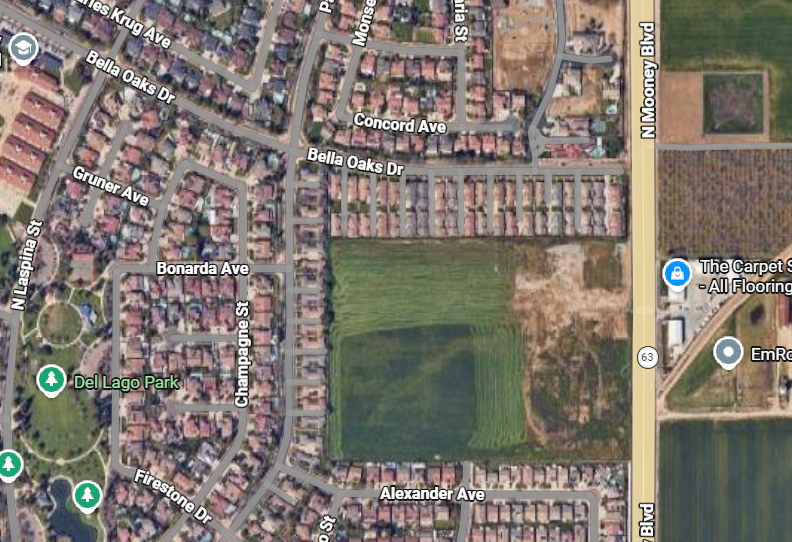
 A weedy 10-acre field on Mooney Boulevard – once home to a rural winery in what used to be the outskirts of town – is now open for development as high-density housing in Tulare. The change, however, split the Tulare City Council and is upsetting residents already living there.
Del Lago Residents Object
The crucial zoning change, city officials said, is necessary to complete a state-required update of the housing element of the city’s general plan. That update is already years overdue and has been underway since 2022. Yet the move still triggered a last-minute outcry by those living in the subdivision that surrounds the rezoned parcel.
The rezoning and updated report to the state were approved April 21 in a 3-1 vote.
A handful of residents of the Del Lago subdivision in northeast Tulare turned out Tuesday night to voice concerns about the zoning change before the council made its final decision. Speaking about the hypothetical increases in traffic and crime that could result from living near multi-story apartment complexes – as well as the loss of privacy and degradation of the neighborhood’s calm atmosphere – they asked the city to preserve the status quo.
“The winery was quiet. It didn’t throw loud parties,” said Del Lago resident Devin Tucker. “It didn’t cause problems. And now nine years later, they’re talking about building multi-level apartments and adding a lot more population to a neighborhood. And that’s just not something we’re interested in. I don’t think that’s a good move.”
Besides upping the area’s housing density, the council also approved giving the owner of the acreage the right to develop the land without City Hall’s OK, as long as the project meets the city’s design standards and fits the new zoning designation.
Those who objected believe it’s too great a degree of freedom.
“A future project that fits the zoning could move forward by right without any other public hearing,” said Trisha Dean, whose Del Lago home is adjacent to the 10-acre plot. “So tonight might be the only opportunity families get to speak before something that much larger and more intense is placed directly behind our homes. This is a big ask of us.”
The land under review is surrounded on three sides by the Del Lago subdivision. Its fourth side faces onto Mooney Boulevard north of Prosperity Avenue. The area is in City Council District 4 and represented by Dennis Mederos. He was not in attendance at Tuesday’s meeting.
No Plans Yet to Develop Rezoned Area
Following the council’s action Tuesday, City Hall no longer has any say about how the property can be developed in the future, no matter what income level it’s aimed at. Any properly zoned high-density housing project has to be allowed to move forward.
However, Mario Anaya, the city’s director of community development, said that doesn’t make it a free-for-all. Any potential future builder must meet the city’s established rules for any project that they propose. And there’s not a construction proposal on the table yet.
“One thing the public should note: There’s no specific project now,” he said. “And even though there’s not a discretionary process in the future if this rezoning is approved, projects still have to go through site-plan review.”
In the meantime, Mayor Patrick Isherwood said the council is aware of neighbors’ safety and quality-of-life concerns, and they intend to review and update city ordinances to preserve the neighborhood’s quiet atmosphere.
“How can we button that up?” Isherwood said. “How can we address those concerns so that when a project comes in front of us, we have these additional items further addressed? We can work through that.”
Vice Mayor Steve Harrell wanted definite protections in place, and he would eventually cast the only no vote against adopting the zoning change and approval of the state-mandated update to the housing element of the city’s general plan.
“I would be more comfortable with something that’s more concrete, that we’re going to protect these people’s privacy, do something about traffic control, traffic calming measures and things like that,” he said. “To be perfectly honest at this point I cannot support this.”
Tulare Experiencing State-Ordered Growing Pains
Rezoning the 10 acres in question presented a perfect opportunity for Tulare to complete and submit a state-required update to the housing element of its general plan. Adding the pocket of high-density housing was the final piece needed to meet the Regional Housing Needs Allocation (RHNA) requirement for the California Department of Housing and Community Development (HCD).
A city’s RHNA (pronounced ree-nah) is an examination of the city’s housing needs based on income and household size. The HCD requires all cities to update their version on an eight-year cycle, and there are eventual consequences for missing the deadline. When Tulare fell short of the high-density requirement by 95 acres in 2018, HCD threatened legal action and fines.
Despite beginning fact-finding in 2022 for the current RHNA, the city is now years behind schedule.
“Each year they seem to have more requirements, and this sixth cycle, if you ask any planner in California that’s worked on it, it was really a gauntlet,” Anaya, the city’s community development director, said. “It took a lot of effort, a lot of years to put together. In hindsight, we would have started earlier. Because here we are kind of behind. We should have had the new one adopted in 2024, so we’re about two years late.”
Tulare wasn’t the only tardy city in Tulare County. Eventually under the umbrella of the Tulare County Association of Governments (TCAG), every city in the county joined forces to complete the more than 500 pages of data needed to satisfy the HCD. During the four-year-long process, the city received only one written comment until the final approval process began.
The update to the housing element of Tulare’s general plan was reviewed by the city’s Planning Commission last month, unanimously approved and then forwarded to the city council. It came with a recommendation of adoption.
Too Much Power and Outdated Outlooks
Despite the state mandate requiring cities to address the housing needs of all their citizens, there was still the claim it represents an overreach of state authority the city should perhaps ignore.
“All I’m asking is to maintain it the way it is, regardless of what Sacramento is trying to push on us,” Del Lago resident Tucker told the council. “Sacramento will be changing soon, because we have an election coming up. So the policies we have now may not be in place in the future.”
While pushing back against the notion that high-density housing leads to bad outcomes, such as increased crime, Councilwoman Terry Sayre said old and familiar biases seemed to be at the root of some of the objections to the rezoning plan.
“I also represent the West Side, and so I’m aware of some of the feelings that are traditional in Tulare about the difference between west and east sides,” she said. “I don’t think the tracks actually delineate people’s worthiness. It’s a mindset that’s been in Tulare a long time.”
According to the TCAG Sixth Cycle report for 2023-2031, Tulare has 4,749 households in total. Of those, 1,435 (30.2%) have very low incomes of less than 50% of the area median income (AMI). Another 884 households (18.6%) have low incomes of 50% to 80% of the AMI; 677 households (14.3%) have moderate incomes of 80% to 120% of the AMI; and the largest and richest portion – 1,753 households (36.9%) – have incomes greater than 120% of the AMI.
Tulare grew by 16.7% between the 2010 and 2020 census counts. That’s more than three and a half times the rate of Tulare County’s growth, and nearly three times the growth rate of the entire state. Yet 77.4% of Tulare’s housing is single-family detached homes.
“We don’t have a lot of variety in our housing stock,” Anaya said. “We kind of produce a lot of the same type, and the needs in our households have changed over the decades, so we’re kind of seeing that bear out a little bit with the data.”
The official conclusion is Tulare needs a wider variety of housing options for all income levels. The county as a whole also needs a greater diversity of housing types. Single-family detached homes make up 75% of available housing, compared with 57.7% statewide.
You snobs! Everyone has apartments near them. You need to learn how to relate to all people and your money 💰 can’t buy you respect.