
 Californians have seen the ominous photo: It depicts a person standing next to a telephone pole that bears a series of signs labeled with years.
At the top of the pole is a sign that reads “1962.” Several feet lower is a sign reading, “1970.” Much further down, another sign says, “2015,” followed by more signs for the years 2019, 2021 and finally a sign at the bottom that reads “2025.” Each sign represents the ground level that year and how far the ground has sunk due to subsidence.
The iconic photo shows how severely subsidence is impacting our valley and how much water is being pumped without being replenished.
And it is getting worse.
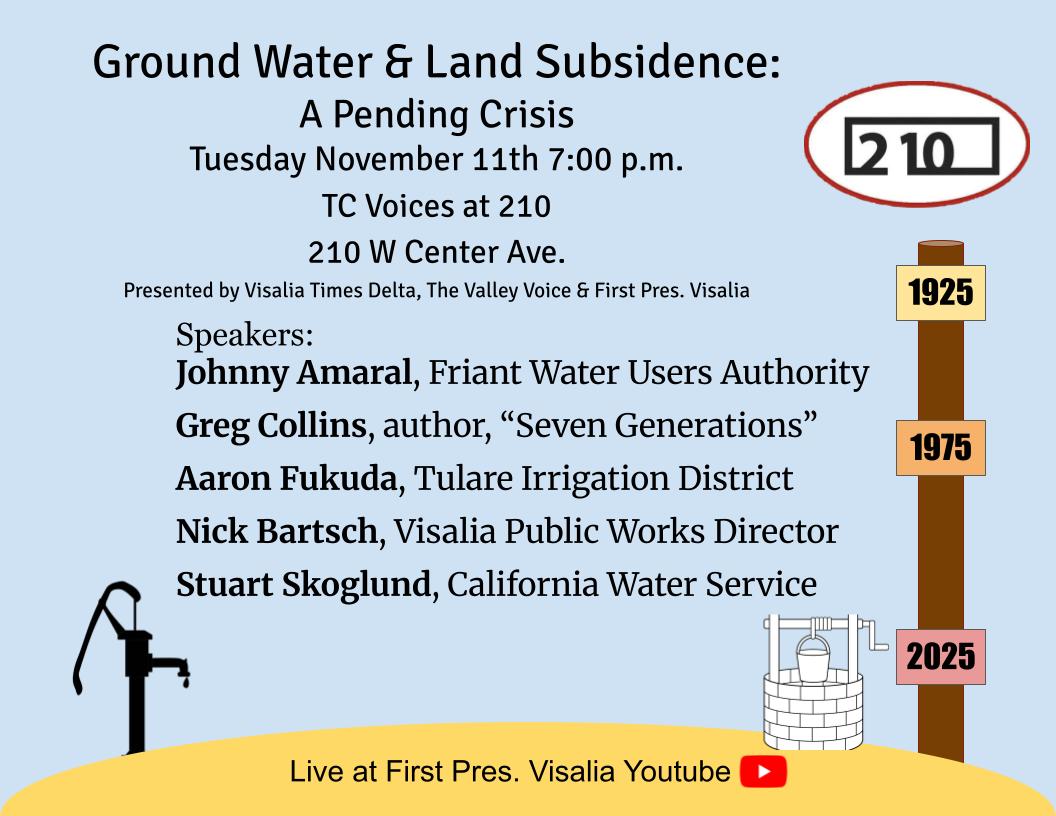
“Groundwater and Land Subsidence – A Pending Crisis” will be a public forum presented by Tulare County Voices at 210, at 7 p.m. on Tuesday, Nov. 11 at 210 W. Center Ave.
Farmers, municipalities, and private well owners in the Valley, are struggling to stop subsidence and maintain our current level of ground water. Cities and farmers are under a state mandate to sustain the current level, and the stakes are nothing less than survival: If those signs keep sinking down that telephone pole, the Valley will literally dry up and blow away.
“Tulare County Voices at 210” is a monthly forum that explores topics of local interest and is co-sponsored by the Visalia Times-Delta, the Valley Voice, and First Presbyterian Church.
This month’s forum will explain what is being done to address the twin issues of groundwater depletion and subsidence. Clearly if those twin issues are not addressed, the Valley faces a dire future, maybe no future at all.
The panel includes:
- Johnny Amaral, Friant Water Users Authority
- Greg Collins, author, former Visalia mayor
- Aaron Fukuda, Tulare Irrigation District, Mid-Kaweah Groundwater Sustainability Agency general manager
What is SGMA?
Maintaining the complicated calculus that supports the multi-billion-dollar ag industry takes intricate agreements among an array of competing interests – family farms, dairies, industrial farms, water rights holders and cities.
Until 2014 every state in the West controlled groundwater pumping except California. To rectify that, the state passed the Sustainable Groundwater Management Act (SGMA) that year. SGMA requires local areas to form groundwater sustainability agencies (GSAs). GSAs develop and implement groundwater sustainability plans (GSPs) to avoid undesirable results and mitigate overdraft within 20 years.
The law requires these groundwater management entities to find ways to limit pumping so that subterranean water tables are not depleted. One strategy is to ensure that no more water is removed from the ground than is returned at 2014 levels, thus achieving sustainability
GSA’s that cannot achieve sustainability by the year 2040 will be penalized by the state and possibly have their water districts taken over. Property owners could be forced to install water meters,or prevented from pumping. They could be fined to raise money to repair infrastructure.
The GSAs have been struggling to develop plans that the state will approve, usually because many areas of the Valley are totally dependent on pumping. Often the only solution is to fallow farmland.
Taking land out of production is anathema to farmers, of course, and they are resisting controls on pumping. But as the ominous photo illustrates, the Valley cannot continue its current course.
Subsidence wrecks havoc on infrastructure, such as roads, bridges, water lines and buildings. Cities and property owners other than farmers have s stake in making SGMA work. Subsidence has already damaged some infrastructure, such as the Friant Kern Canal. Millions of dollars were spent to repair and reroute the canal only to have subsidence damage the canal again.
Some GSAs have had their water management plans approved, some are on the path toward compliance, while others are in danger of being taken over by the state.
Perpetually designated in critical overdraft, the Valley is a long way from a solution.
The various interests are trying to work together, and in California where whiskey is for drinking and water is for fighting over, that represents progress.
The forum on Nov. 11 is intended to review that progress and explore the next steps.
Join the discussion, and become part of the community conversation.