
 Narrowing a stretch of Visalia’s Tulare Avenue to improve bicyclist safety will proceed despite complaints from some residents who live along that busy crosstown corridor. Now, however, adjustments to the controversial plan are in the works that could ease the parking situation without creating undue risk to bike riders.
Plan to Upgrade Bike Lanes Was Years in the Making
The plan to remake Tulare Avenue isn’t a new one. The idea was first approved by the City Council in 2021 during a push to make California’s cities more bicycle-friendly. The new design puts bike riders directly against the sidewalk. Low barriers define the outside of the bike lane and prevent encroachment by passing cars.
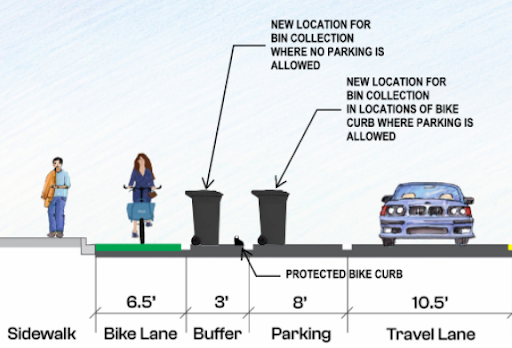
But the scheme also requires that cars parked on Tulare Avenue be beyond the sidewalks and bike lanes. That puts them next to the lanes full of passing cars, significantly narrowing the room for traffic. It also means a lot of parking spaces have been eliminated. The loss of parking spots is inconvenient, and the 7-foot gap between the street’s edge and the parking lanes has some residents concerned for their safety and the safety of their parked cars.
Their concern is so great the council decided to revisit the issue in November, four and a half years after it was first approved. On Monday, November 17, the council approved an alternative plan that may help satisfy both the need for rider safety and parking convenience. But it wasn’t accepted unanimously.
Federal Funding Clock is Ticking
Until this year, Tulare Avenue from Santa Fe to Demaree streets had Class 2 bike lanes. Those are the usual pair of unbroken white lines that define an area for bikes directly next to the lanes of traffic. Tulare Avenue was the Visalia roadway first considered for an upgrade to Class 4 bike lanes perhaps because most of the traffic accidents involving bikes and pedestrians in Visalia happen along that stretch.
Tulare Avenue is also a direct route to the Santa Fe Trail.
The city first considered creating Class 4 bike lines back in spring of 2021. In May of that year, the city mailed out surveys on the topic, and it held public workshops to answer questions and address possible concerns. By summer’s start, Class 4 bike lanes were back in front of the City Council for consideration – this time with the public’s feedback – and on June 7, 2021 the council OK’d Class 4 bike lanes for both sides of Tulare Avenue from Santa Fe Street west to Demaree Street.
Then the money to pay for it was secured. About a year later, on July 18, 2022, $2.9 million in federal funding was accepted for the project. A year after that, on June 5, 2023, $400,000 in SB1 funding from the state was earmarked for bike lanes.
The project should have been finished this month, but the decision to revisit the plan has shifted that timeline. The project is now expected to end by January 30, 2026. The city must have its paperwork filed with the federal funding agency by April 1, 2026, and extending that deadline is not possible.
“The one thing I do want to stress … is we do have a federal funding deadline on this project that’s coming up very quickly,” city engineer Chris Crawford told the council at the November 17 meeting.
Survey Said Residents Wanted Safer Bike Lanes
Back in 2021, the city was eager to move on the project. When results came back from the survey of 2,300 citizens, support for the new bike lanes was 56%. Those opposed made up 30%, and 14% of those who responded had no preference.
Approving the project also improved the city’s chances of getting additional grant funding for other traffic projects. Having a plan to upgrade Tulare Avenue bike lanes in hand helped the city win another $11.3 million for the Santa Fe Trail project.
While the numbers looked good, they may not have reflected real opinion. Only 4% of the 2,300 surveyed by mail responded. Information about the project was sent by mail, and those living on Tulare Avenue received phone calls about it. Yet only 13 people showed up for the workshop.
The failure to communicate the scale and scope of the project could be why the council is now revisiting the issue. But it’s very late in the process.
“The big thing is we need people to show up to those (community workshops),” Crawford said. “It’s a lot easier for staff to design around issues we’re aware of, because once we get to construction, it’s extremely hard to change some of those things.”
The first of three phases in the project is already complete. Tulare Avenue from Mooney Boulevard to Watson Street has been repaved and the new lane and parking stripes have been painted. The only thing lacking is signage. Work on Tulare Avenue from Mooney to Demaree Street is ongoing, with paving complete and bike lane striping and signage to come. The final phase – Tulare Avenue from Watson to Cotta Street – has been paved, but no stripes have been painted there.
The upgrades will cover a five-mile corridor when complete.
Altered Bike Lane Plan Addresses Residents’ Concerns
Despite the late timing, the number of complaints prompted the city to reconsider the issue for alternatives that would ease problems, real or perceived. Among the concerns that seem to have real merit is the likelihood cars parked beyond the bike lanes could be struck by passing vehicles.
“There’s not much room if you’re driving a larger truck, so I just wonder about accidents and the safety,” said Visalian Arvella Franzen. She also said she doesn’t understand the new symbols the city has painted to mark the bike lanes.
Other concerns include garbage trucks blocking the narrowed traffic lanes, difficulties for those with disabilities, the current high speeds on Tulare Avenue, and of course the loss of parking spots.
The alternative plan approved last month on a 3-1 vote from the council addresses these issues. The city will widen the parking spots, meaning the driver-side doors will be further from moving traffic. City engineers will revisit their plans to find spots for added parking, and a speed study will be performed in anticipation of lowering speed limits in some areas. But the Class 4 bike lanes stay.
Bicyclist Laura Anderson said she’s pleased the city is moving forward with safer spaces for bikes.
“I really appreciate having a protected bike lane on my route,” she said. “It’s made me choose to go down that street as opposed to other streets. I feel safest when I’m riding on that street.”
Anderson would like to see more Class 4 bike lanes around town, especially since it makes her more comfortable when riding with her daughter.
“She’s younger, and that’s one of the streets where I feel like she’s safe and protected from the traffic,” she said.
New Bike Lanes May Put Residents at Risk
Robert Stavely, who has lived on Tulare Avenue west of Demaree for 45 years, is concerned with how drastically the new bike lanes cut into the street. Tulare Avenue by his home, he said, will go from 60 feet wide to about half that.
“Not only is it dangerous for our vehicles, for our family members getting in and out of vehicles, the flow of traffic, which is rather heavy down that corridor, we have a chance of getting hit on both sides,” he said.
Bike traffic is low in his neighborhood, Stavely said, and drivers will be in danger of running into cars parked up to 15 feet from the sidewalks.
Mike Pinero, also a longtime resident of that section of Tulare Avenue, is worried about how the change to the street’s layout will affect his property values. And he doesn’t like not being able to park directly in front of his home.
“Put it back where it was,” Pinero said. “It’s fine.”
Tulare Ave. Bike Lanes Part of a Bigger Picture
The bike route down Tulare Avenue is part of a larger scheme to make Visalia a more bikeable town. The portion being reworked is one part of a larger network of bike- and pedestrian-friendly projects already in the planning process.
“We have a lot of things going on that are going to be interconnected,” Crawford said.
Tulare Avenue is also home to more schools than any other street in Visalia. Several elementary schools, Mt. Whitney High School, Divisadero Middle School and the College of Sequoias, all of them border Tulare Avenue along the five-mile stretch of the project. Protected bike lanes will give children safer paths to school.
It could be that education and familiarity will help alleviate some residents’ concerns about the change.
“We understand these (protected bike lanes) are relatively new for a lot of people in the community,” city engineer Crawford said. “It kind of reminds me a lot of the roundabout issues we went through about 10 years ago. Everybody kind of likes them now.”
As part of the grant funding used to pay for the upgraded bike lanes, the city received $1.3 million to spread the word about the safer bike lanes, and education efforts will soon be underway.
“Over the next three to four years, the city’s biggest educational effort will happen to support using the bike infrastructure,” Crawford said.
Visalian Lisa Alvarado, an avid bike-rider, said she understands the concerns raised by the new bike lane, especially given the lack of participation in the 2021 survey, but safety should be the city’s overriding priority.
“Residents are worried about parking stalls. … I’m worried about my life,” she said. “I’m OK with someone walking 50 feet. I’m not OK with losing anybody.”
Id drive around and count how many people ride bikes. Lots of planning of and for nothing… Roads were built for horses and cars not bikes. Delusional people will tell you we live in a high speed train era too.
The majority of bicycle riders I see are violating traffic laws and thereby creating a risk for ALL community members traveling on or near the streets. All the paint in the world will not change their selfish and reckless behavior. Too bad the road money can’t be allocated to law enforcement to monitor these riders. Take away their bike until they attend a free safety class . Also need Share the Road signs aimed at bicycle riders.