

Those images are the dramatic tip of the iceberg of the nation’s changing approach to immigration enforcement. Less visible are the disruptions to peoples’ daily lives – decisions to stay home from school or work, or avoid a market or public gathering. No headlines announce the loss of worker productivity, school attendance, or delays in construction projects. Those are consequences of the immigration enforcement also.
Tulare County is home to about 40,000 undocumented immigrants, about half of whom work in agriculture, according to estimates by the Migration Policy Institute.
How has immigration policy enforcement affected our communities, where nearly one in 12 people are undocumented? How are those people and institutions coping? And how are our ag and construction companies coping?
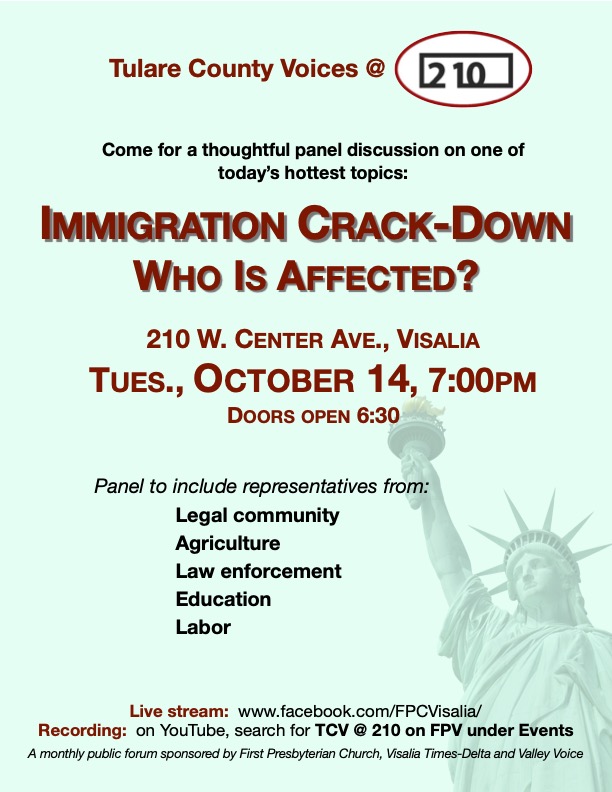
That will be the subject of our next discussion at Tulare County Voices at 210: “Immigration Crack-down: Who is affected?” at 7 p.m. on Tuesday, October 14, at 210, 210 W. Center Ave.
“Tulare County Voices at 210” is a monthly forum co-sponsored by the Visalia Times-Delta, the Valley Voice, and First Presbyterian Church that explores topics of local interest.
The purpose of our forum at 210 will be to encourage a discussion on how industries and institutions think these policies are affecting their day-to-day business and how they plan on addressing any changes in the future.
Invited to attend this discussion as panelists:
Roberto M. de la Rosa, JD, President of O.L.A. Raza
Jose Sigala, councilman from Tulare
Tulare County Sheriff’s Office
Bryant Macias of United Farm Workers Foundation
Tim Hire, Tulare County Superintendent of Education
The 2020 U.S. Census concluded that some San Joaquin Valley communities have as much as 95 percent undocumented immigrants in their populations. The construction, hospitality and agriculture industries all acknowledge that they rely on new immigrants.
But unlike other areas of California there have been few reports of mass detentions or so-called roundups of undocumented individuals.
Local school administrators say attendance and enrollment in their schools have been mildly affected at worst.
But how have local restaurants, hotels and motels been affected? How about local construction projects?
And how has the local immigrant community coped with a more aggressive enforcement program that could threaten family members, coworkers and friends?
The purpose of our forum at 210 will be to encourage a discussion on how industries and institutions think these policies are affecting their day-to-day business and how they plan on addressing any changes in the future.
One of the most important aspects of this discussion will be to learn how those who serve new immigrants are advising their clients.
All those sectors in their own way have pursued solutions to the immigration problem for years. Tightened enforcement has increased the pressure to find those solutions.
The discussion at Tulare County voices at 210 could open another path to finding those solutions.
Join us at 210 on October 14 and join the community conversation.