

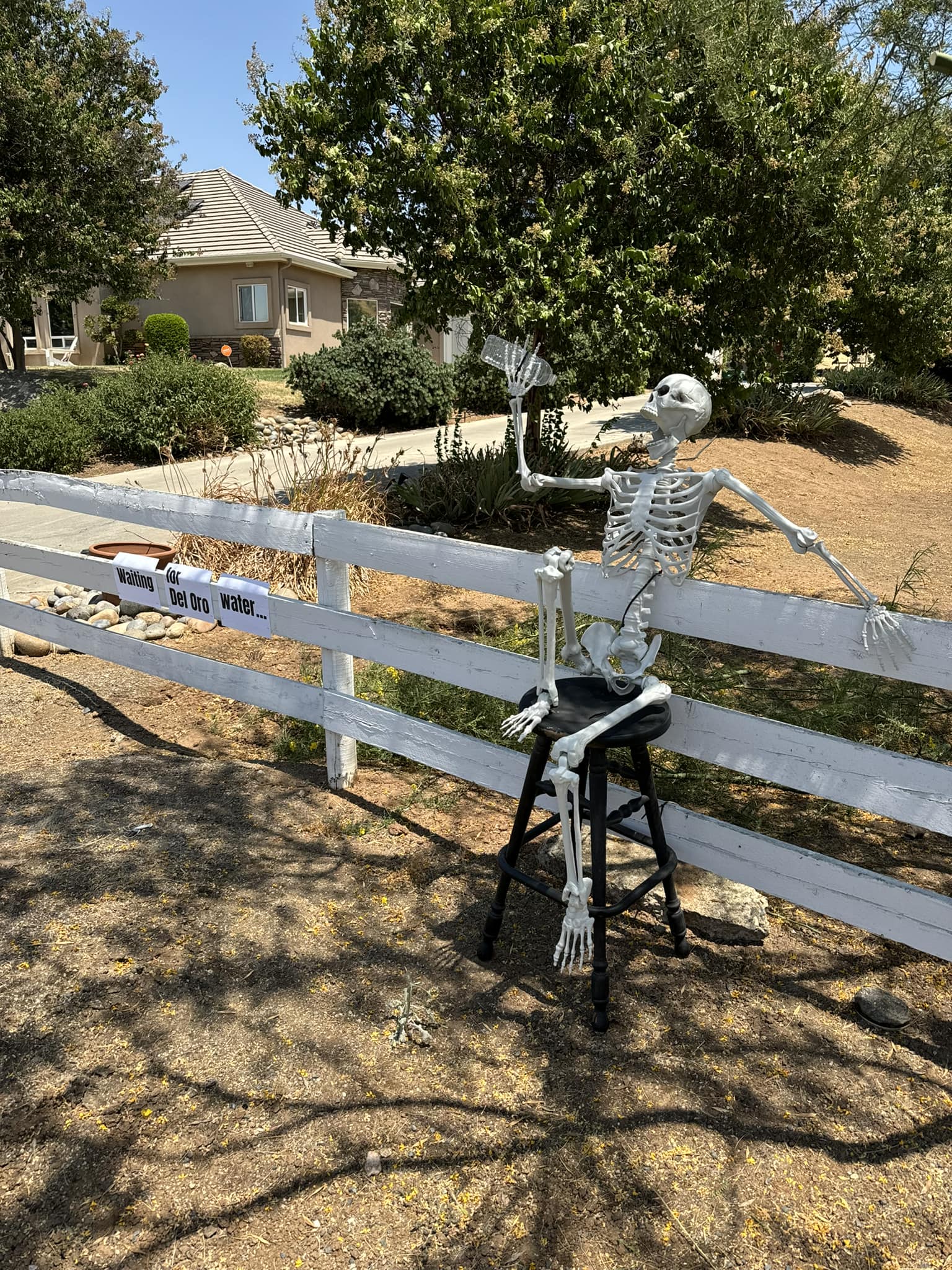
A group of angry local residential water customers intends to flood the California Public Utilities Commission (CPUC) with a deluge of complaints to prevent their drinking water provider – Del Oro Water Company River Island – from getting its second rate increase in two years despite numerous claims of substandard service by their parched clientele.
Utilities Commission Weighing 12.88% Rate Hike
For years now, the residents of a small Springville neighborhood have been fighting to secure a safe, reliable and adequate supply of drinking water to their homes. And for just as long, these thirsty foothills residents claim, the absentee owners of Del Oro – or DOWCRI, as it’s called in state and company documents – have resisted meeting their contractual obligation to provide it.
Along the way – through historic drought, record flooding and ongoing contamination – Del Oro never stopped charging top dollar for the hit-and-miss service they provided. Customers received bills even when the water didn’t run at all. And they were also hit with periodic rate increases despite the alleged lack of performance on Del Oro’s part.
Residents of the DOWCRI – an area of Springville that includes the River Island Golf Course and many of the surrounding homes – say they’re furious at the audacity of asking for more money without delivering the promised product.
“For years we didn’t have safe drinking water, and still got charged insane amounts,” said Raffaella Woods, whose home is within the DOWCRI and who is leading the effort to get the state to act on their behalf. “Even when we had no water we got charged. We were getting bills of $600-$700 when we were getting no water.”
Now, Del Oro is asking the CPUC for another rate increase, this one an additional 12.88%. Should the state regulators approve it, it will be the second increase in two years.
The state will decide on the rate increase no earlier than the CPUC meeting set for October 30 at the CalEPA offices in Sacramento. However, the CPUC will not release the meeting agenda until October 20. Those who wish to protest the rate increase must do so by September 30. CPUC staff is scheduled to complete its review of the request and objections by October 10.
Springville Residents Claim Water Company is Dishonest
Further muddying the waters are claims by the high-and-dry customers that Del Oro has not dealt with them in good faith. Specifically, the Springvillians claim Del Oro received a large grant from the state that should have lowered the customers’ share of cost for a recently completed water treatment facility. Instead, the company waited until now – years after learning the state had lessened Del Oro’s debt load – before acting on the fact. And in the meantime it continued charging its customers more than it was repaying the state.
Now that Del Oro is asking the state to reduce the customer surcharge, it’s requesting another permanent rate increase for DOWCRI residents. The newest request for more money, Del Oro said in a letter to the CPUC dated August 20, is intended to cover the cost of past engineering costs and unexpected project expenses for the now complete and operating water treatment plant.
The request for an open-ended rate increase to cover a set of one-time expenses related to a single project also has Del Oro’s local customers boiling over.
“It’s weird the way they’re doing it,” said Woods. “They’re saying they spent $83,000 for unexpected costs for the water treatment plant. Now, they want us to pay back $673,000, and they say they have the receipts.”
But, she said, Del Oro has so far refused to provide documentation of the costs they hope to reclaim. Woods also said Del Oro has continuously refused to provide the details of the contract with DOWCRI residents, which the company obtained by buying out the original water provider. It claims its customers are not entitled to know proprietary company details, she said. Del Oro has also misrepresented the quality and effectiveness of its service in state documents.
“Why would they ask for a permanent increase for a temporary cost?” Wood said. “It’s because they’re crooks.”
To support this statement, Woods points to a grand jury investigation in Nevada County in 2001. According to a contemporary report from the Sierra Sun News, the grand jury found the Del Oro-owned Donner Lake Water Company failed to comply with state water regulations for more than seven years and “presented an attitude of indifference.” Release of the grand jury report coincided with a government takeover of the Donner Lake Water Company by eminent domain, a move Del Oro did not contest.
Springville’s Water Troubles Started During Drought Years
Officials in Nevada County, the grand jury found, should have done more to pressure Del Oro and state water officials into action. Their ability to do that, as is now the case in Tulare County, was hampered by state control of water law and enforcement. But even though county officials’ hands are largely tied, Supervisor Dennis Townsend said he’s been doing what he can since the problems began.
The chain of events started in 2021 at the peak of an historic drought in the Western US.
“It was a long battle, and all the neighbors had been complaining for a long time about Del Oro,” Townsend said. “First it wasn’t (providing) quality water, then it wasn’t enough. Then after the flood, their wells got taken out and it got worse.”
As the arid conditions went on, water tables sank due to overpumping. That in turn led to the concentration of contaminants, specifically nitrates from fertilizer runoff and radioactive uranium, which is present in the surrounding Sierra Nevada. Eventually, the water stopped flowing regularly to customers.
Townsend said he tried direct intervention on the Springville residents’ part, but to no avail.
“We tried to negotiate back and forth with Del Oro. I even had direct conversations with the ownership,” Townsend said. ”I said maybe we can find a way to fill your empty tanks with water from the Porterville system. They actually refused the help. They said there’s no way you can do that. It’s impossible.”
Woods described months-long periods where residents intermittently had no running water and she wasn’t delicate.
“They wouldn’t even let us truck in our own water,” she said. “They basically said you’re shit out of luck.”
When climate conditions changed again and the rains returned at record rates in 2023, flooding contaminated additional Del Oro wells, worsening the problem.
Three Decades of Bad Water from Del Oro Water Co.
According to an historical account of residents’ dealings with Del Oro that Woods provided, the company has failed to meet the state’s minimum safe drinking water since 1997. To correct the decades-old problem, Del Oro began planning a water treatment plant to remove contaminants and bring them into compliance with state standards. That was in 2009 following the issuance of compliance orders from the California Department of Public Health.
Eight years later in 2017, the company announced that its plans for the treatment plant were under final review by state officials. Construction, they said, would begin in 2018. However, construction did not begin until 2021. Del Oro said the plant would be online in 2023.
It finally began filtering contaminants in July of 2024, 15 years after the project was announced.
During that period, the residents of DOWCIR repeatedly found themselves without water. During the 2023 flooding of Springville by the Tule River, five of the Del Oro wells were wiped out. The company maintained no flood insurance, despite two of the wells’ location on the river and three other wells sited in the river’s flood plain.
During that period, Woods said, she and her neighbors had no water at all for five days. When water was restored, customers were provided with nonpotable irrigation water for two months. The water was not fit, she said, for any use by humans.
“We were not even allowed to shower in it. It was just not safe,” Woods said. “They did eventually provide us with bottled water, but only six gallons per house no matter how many people there were. Then they asked for the money back.”
Despite not delivering water during that period, Del Oro continued to charge its customers at the “ready to serve” level. And when service was partially restored, Woods said the water delivered was still over state limits for contaminating pollutants. And it only ran eight hours a day until the water treatment plant finally began operating. Twice during that period – from June 14 to July 5 and again from July 9 to July 29, 2024 – Del Oro issued warnings to customers not to use water the company supplied.
Customers Suspect Del Oro Claiming More Than It’s Owed
During the flooding disaster and its aftermath, Del Oro officials asked the CPUC for a rate increase for the DOWCRI. Woods claimed the already distracted residents were not adequately notified of the request by Del Oro. The rate increase was approved in 2024.
Now, the company is asking for another increase. According to paperwork filed with the CPUC by Del Oro, ownership is seeking both a decrease in the amount DOWCRI customers pay to cover the $9 million state loan that covered the cost of constructing the much-delayed water treatment plant, and a fixed increase of 12.88% to cover engineering costs and unexpected expenses resulting from the project.
While Del Oro originally borrowed $9 million in state funds for its project, it eventually received a grant that offset approximately $4 million of their burden. That happened in November 2022, yet Del Oro made no request to reduce customers’ bills to reflect the change until now. That means customers have been overpaying for 21 months while Del Oro made no move to correct the imbalance.
If the CPUC grants the reduction, Del Oro claims its customers will save $32.67 a month.
However, the 12.88% rate increase Del Oro is also requesting will permanently increase all bills by an amount that will vary depending on usage. The company claims it needs the increase to recoup nearly $700,000 in unforeseen costs of the water treatment plant dating back as far as 2011. It has refused to meet DOWCRI customers’ demands for an accounting of those costs, Woods said.
She and her fellow affected customers have a very specific set of stipulations they’d like from the CPUC.
“We want to not have a rate increase, and if they’re claiming to spend that much money on us, why were we never told?” she said. “And we only want to pay them back what they’re owed, and we want to see receipts. We don’t want a permanent 13% rate increase.”
In the meantime, Supervisor Townsend says his constituents still aren’t sure their water is entirely safe.
“They’re still not comfortable that they’ve got good, clean, pure drinking water, and now they’re getting hit with another rate increase,” he said. “I’ll continue to do what I can to advocate for them. I think the best recourse is to protest to the CPUC.”
That is the DOWCIR customers’ only recourse, since local authorities can do almost nothing to help beyond bending the reluctant ears of state legislators.
“It’s an interesting and frustrating dynamic that the local agency doesn’t have jurisdiction,” said Townsend. “We’ll do everything we can to help. We’re going to help advocate.”